

Following the success of Convertors, Select Merchandise looked to expand its portfolio beyond transforming robots. Rather than relying on a single flagship brand, the company sought to capitalize on the growing popularity of martial arts and military action toys that defined the mid-1980s. The result was Ninja Assassins and Ninja Defenders, released in 1985.
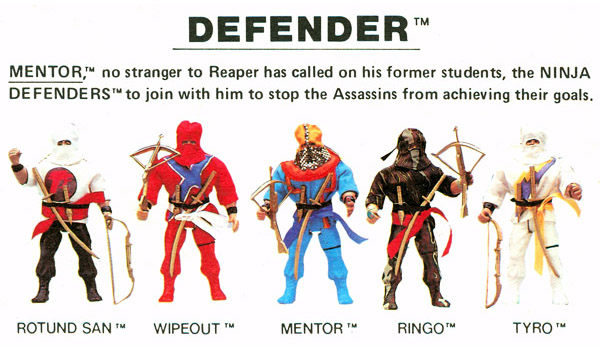
The premise was straightforward, but memorable. Reaper, the Grand Master of Death, had returned to conquer the Earth. To carry out his plans, he resurrected history’s greatest killers and assembled them into the Ninja Assassins. Standing against them was Mentor, the world’s greatest martial arts master, who reunited his former students as the Ninja Defenders to stop Reaper before humanity was destroyed.
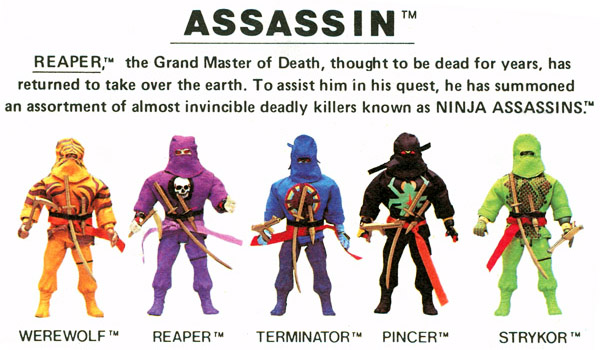
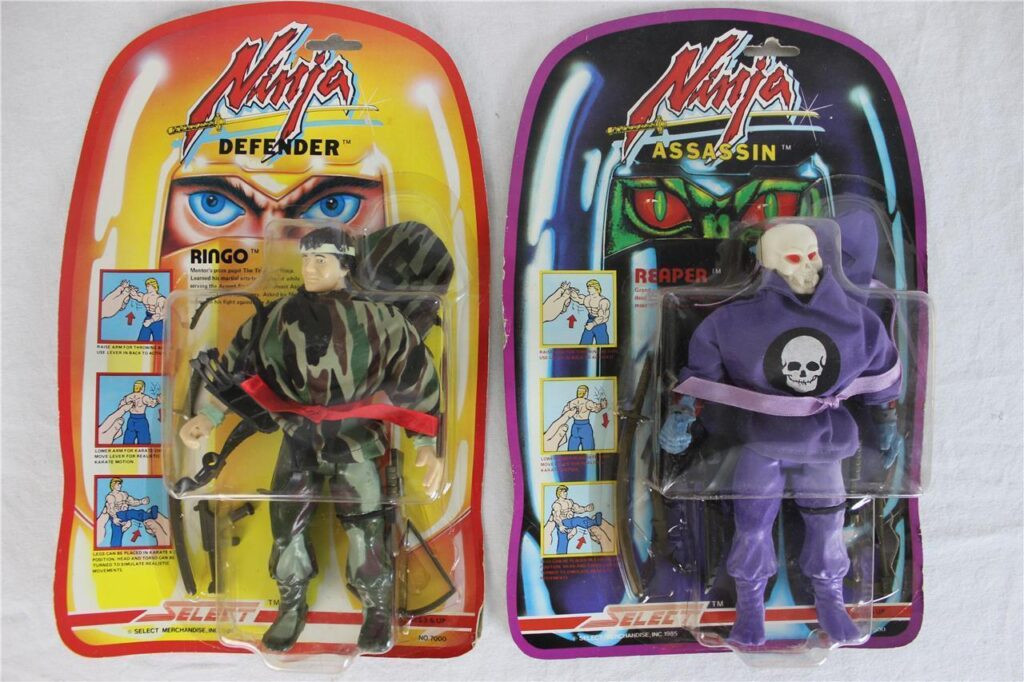
The line consisted of ten 7-inch action figures, divided evenly between the heroic Defenders and villainous Assassins. Each featured a spring-loaded karate-chop action feature, removable cloth gi, and a generous assortment of martial arts weapons. Although simple by modern standards, the figures offered exceptional value for their price and compared favorably with many competing action figure lines of the era.
The figures were widely distributed through major retailers, including Toys “R” Us, KB Toys, Sears, JCPenney, Child World, and Children’s Palace, Walgrens and Eckards, with at prices ranging from $3.99 to $9.95 depending upon the retailer and seasonal promotions. The combination of attractive packaging, cloth goods, and low price made Ninja one of the strongest values available in the action figure market.
Perhaps the most striking feature of the line was its presentation. The blister card artwork remains among the finest produced by Select Merchandise. Combined with the colorful uniforms and distinctive accessories, the line possessed a visual identity that stood apart from the increasingly military aesthetic dominating toy aisles in the mid-1980s.
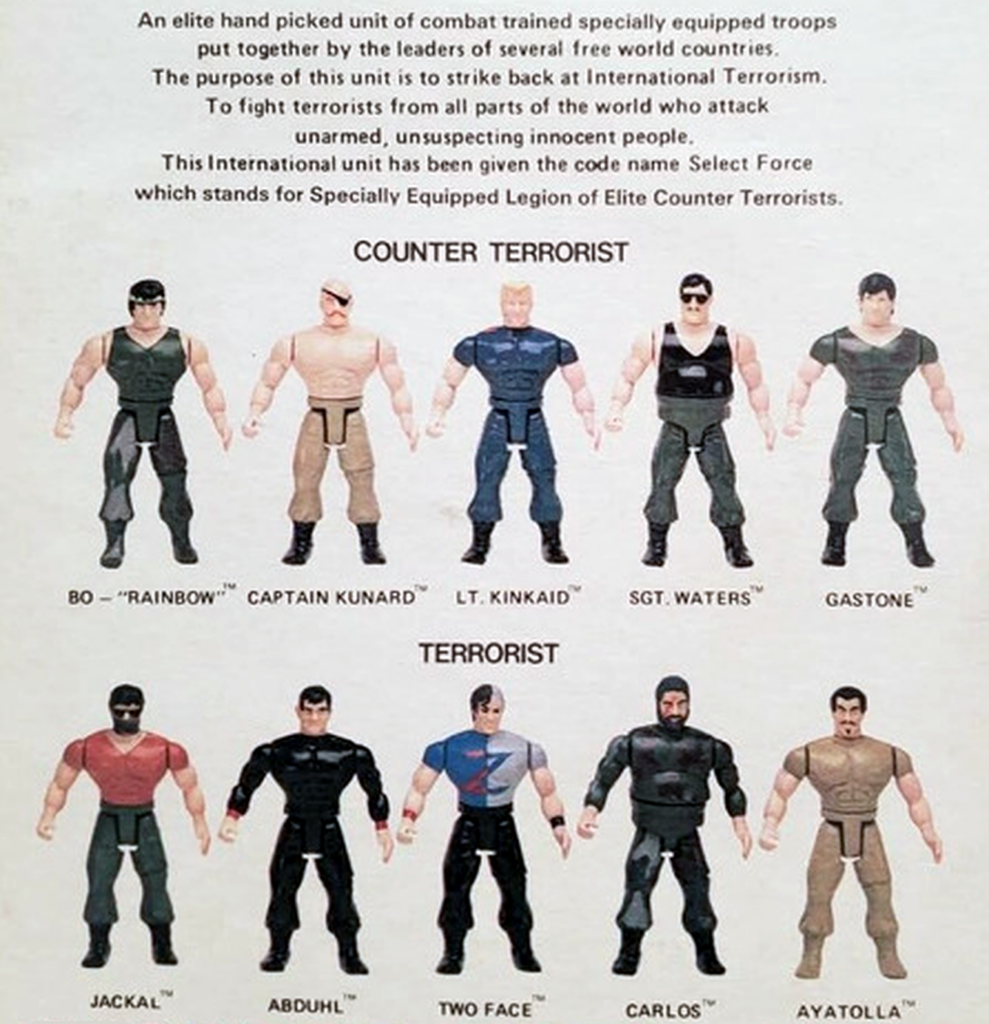
In 1986, Select followed Ninja with S.E.L.E.C.T. Force. While the figures shared the same basic scale and construction as Ninja, the spring-loaded action features were removed in favor of a more realistic military action. The storyline shifted from supernatural fantasy, toward that of contemporary military action, reflecting the enormous popularity of G.I. Joe and the action films of the day.

S.E.L.E.C.T. Force, Specially Equipped Legion of Elite Counter Terrorists, brought together an international team of highly trained operatives to combat global terrorism. Veteran character Ringo returned from the Ninja line as the team’s leader, providing one of the few direct narrative links between the two series. Opposing him was a multinational roster of terrorists drawn from around the world, giving the line a distinctly international flavor.
Unlike Ninja, S.E.L.E.C.T. Force proved considerably less successful at retail. The line suffered a much shorter production run, and surviving examples are significantly more difficult to locate today. Complete carded figures are among the rarer products in the Select catalog, and are highly sought after by collectors.
In 1986, Select Merchandise expanded its martial arts offerings with two smaller budget-oriented lines, Ninja Warlords and Karate Command. Produced in Korea and sold in Canada, these smaller figures abandoned the cloth uniforms and elaborate accessories of the earlier Ninja Assassin and Ninja Defender lines in favor of compact plastic figures with built-in action features. Although little documentation survives, their simplified construction and economical packaging suggest that Select was intentionally targeting a lower price point, ensuring the line remained accessible to all families across a wide range of incomes, while continuing the company’s emphasis on dynamic painted card art and action-oriented play.
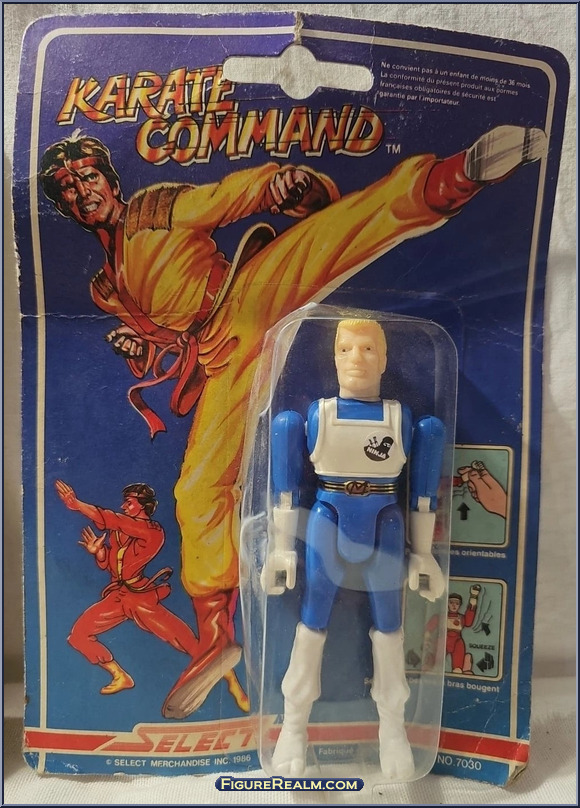
From a manufacturing standpoint, the Ninja family of toys also marked an important transition within Select Merchandise itself. Unlike the earliest Convertors and MuscleMan figures, which were manufactured in Japan, both Ninja and S.E.L.E.C.T. Force were produced in South Korea, much like the later Musclemania figures. Although largely invisible to consumers at the time, this gradual transition away from Japanese manufacturing foreshadowed the broader changes that would shape the company’s later years, and the toy industry as a whole.
