By the mid-1980s, the home video cassette market had become nearly universal. VHS tapes had transformed home entertainment, and toy companies quickly began asking the obvious question: if children already owned a VCR, could it also become a video game console?
Several companies attempted to answer that question. Worlds of Wonder released the Action Max, View-Master developed Interactive Vision, and Select Merchandise entered the race with what would become one of the company’s most technically ambitious products: Video Challenger.
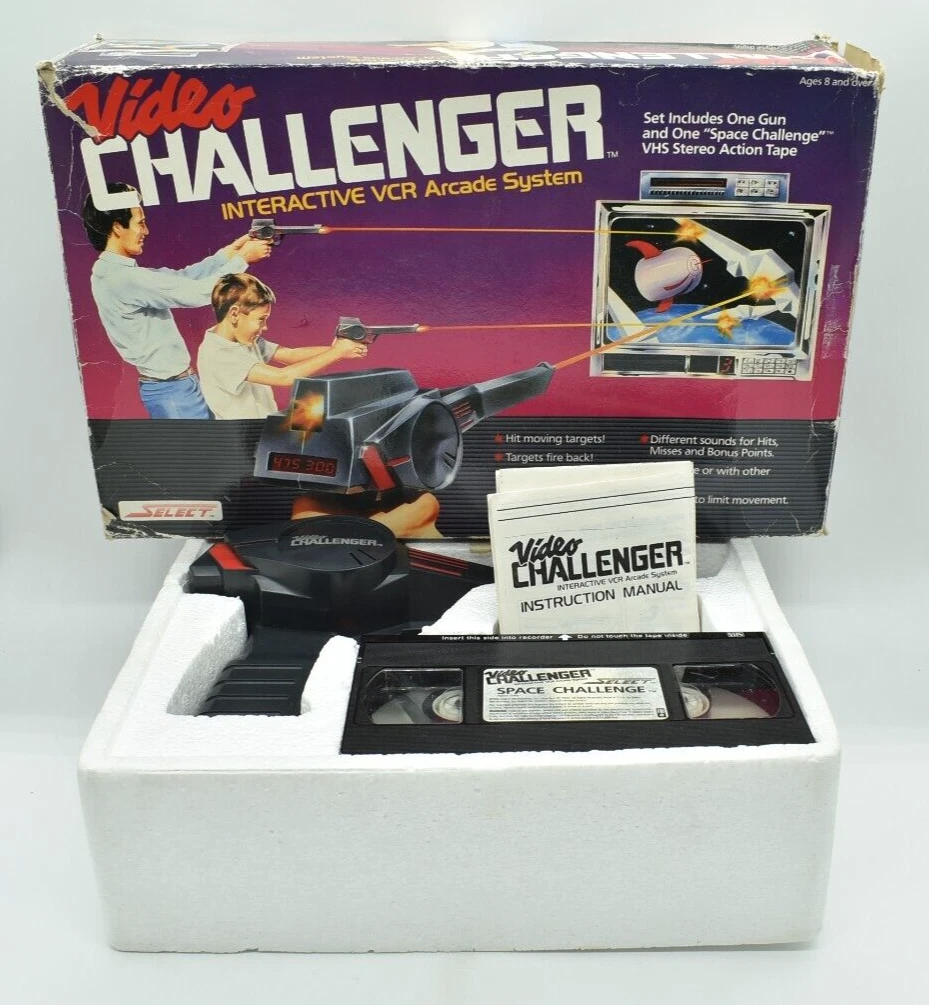
Released in 1987, Video Challenger was a VHS-based interactive video game system built around a photo-sensitive light gun known as the Challenge Blaster, similar to Nintendo’s Duck Hunt or Mattel’s Captain Power. Rather than using a traditional game console, all of the electronics were housed inside the blaster itself. Players simply inserted a VHS tape into any VCR, and fired at flashing targets displayed on the television screen. The blaster detected specially encoded light patterns within the video, awarding or subtracting points depending upon the targets struck. Unlike many competing systems, enemies could also “shoot back,” deducting points from the player’s score and creating a more arcade-like experience.
Beck-Tech in California was hired to handle the video production for Select. Steve Beck handled the writing and direction, while Jack Winters, a pivotal member of the Select Merchandise family, worked as producer on all the games.
The system represented one of Select Merchandise’s most ambitious international products. While Select handled development of both the hardware and software, distribution was shared among several of the toy industry’s largest companies. Select released the system in the United States, while Select partnered with Takara to distribute it in Japan, and Irwin Toys in Canada. Japanese released were marked with both Takara and Select trademarks, while Canadian releases were direct repackages of Select stock. Select also licensed it to Bandai, who brought it to the United Kingdom, and GiG who released it in Italy.
Between 1987 and 1990, a total of eight games were released for the system:
- Space Challenge — Select
- Sky Wars — Select
- Thunder Storm — Data East
- Road Blaster — Data East
- Godzilla Challenger 1 — Takara
- Godzilla Challenger 2 — Takara
- After Burner II — Sega
- TMNT: Turtle Challenge — Bandai
These licensed releases gave Video Challenger a surprisingly impressive software library for such a short-lived system. Takara even modified the opening sequence of Transformers Headmasters to include Video Challenger-compatible targets, allowing viewers to interact with the television series using their Challenge Blaster, and even include the Challenge Blaster in the show. Turtle Challenge featured new animation for Teenage Mutant Hero Turtles, and was a Bandai exclusive only released in the UK. Likewise, Sega and Data East adapted footage from their popular arcade titles into interactive shooting experiences.
Additionally, the system was fully compatible with Captain Power and the Soldiers of the Future VHS training tapes produced by Mattel, adding an additional three tapes to the roster.
Although Video Challenger never achieved the commercial success of Nintendo’s rapidly expanding home console business, it represented possibly the best interpretation of the VHS game concept. The Challenge Blaster could distinguish between multiple flashing target patterns, support multiplayer without connecting multiple guns together, and even penalize players when enemy fire struck the screen. These innovations gave the system a level of interactivity beyond many of its contemporaries.
Ultimately, however, Video Challenger entered the market at precisely the wrong moment. As the Nintendo Entertainment System transformed expectations for home gaming, consumers increasingly expected software-driven experiences rather than prerecorded video. VHS gaming, while innovative, became a technological dead end. While Video Challenger survived as long as Select, its waning sales were not enough to keep the company afloat by itself.
Ironically, that same design decision that limited the system’s commercial future has become one of its greatest strengths as a collectible. Because nearly all of the electronics are contained within the Challenge Blaster itself rather than in an external console, surviving systems remain remarkably reliable decades later. The original VHS tapes have been digitally preserved by enthusiasts, allowing modern collectors to experience Video Challenger almost exactly as players did in the late 1980s. While there is not the vibrant homebrew scene that other game consoles possess, the technology is simple and remarkably adaptable, making custom comes infinitely possible.
Although often overshadowed by Nintendo and Sega, Video Challenger remains one of Select Merchandise’s most ambitious accomplishments. It demonstrated that a comparatively small company could not only compete internationally, but also develop original hardware sophisticated enough to attract partnerships with companies such as Takara, Bandai, Sega, and Data East. Few products better illustrate the scope of Select’s ambitions during the final years of the company.